Carbon neutrality, a global challenge
29/07/2026
All LuminoKrom® news
Table of contents


Faced with increasingly extreme weather events and repeated warnings from the IPCC about the need to drastically reduce global greenhouse gas emissions, carbon neutrality is gradually becoming an essential goal.

This is fundamentally redefining the way governments, local authorities and businesses approach development, land use planning and innovation.

Achieving this balance requires us to rethink our infrastructure, mobility and production methods. In this context, innovative solutions are emerging to reduce energy consumption and limit emissions. Among them, LuminoKrom® offers a concrete and sustainable approach to improving night-time visibility without electricity.

Carbon neutrality : what is it?

Definition of carbon neutrality

Carbon neutrality does not mean completely eliminating greenhouse gas emissions.

According to the European Parliament's definition, carbon neutrality is "the balance between carbon emissions and carbon absorption from the atmosphere by carbon sinks" (technological or natural). Natural carbon sinks include forests, oceans and soils. This balance means that residual emissions must be offset by absorption or sequestration mechanisms.

The goal is to achieve net zero emissions.

Carbon neutrality : understanding a major challenge


Carbon neutrality is now a central objective of global climate policy. This concept is not simply an aspiration: it is at the heart of international commitments.

The Paris Agreement, signed by nearly 200 countries, and the European Green Deal make carbon neutrality by 2050 a binding objective for the European Union. This goal is in line with the scientific framework established by the IPCC, which states that in order to limit global warming to below 1.5°C to 2°C (the threshold at which the consequences of climate change become severe and difficult to contain), global CO₂ emissions must reach net zero around the middle of the 21st century.

Achieving carbon neutrality requires a profound transformation. It is necessary to reduce emissions, develop solutions to significantly increase carbon absorption capacity, and also change our modes of production, development and consumption in order to sustainably reduce our carbon footprint. This includes the preservation and expansion of natural sinks, but also technological innovation in CO₂ capture.

The European Union has set itself an ambitious goal : to achieve carbon neutrality by 2050, involving rapid and profound transitions in all economic sectors.


Key drivers for achieving carbon neutrality

puits de carbone naturels


Several levers have been identified in order to achieve this ambitious goal :

  • Reducing emissions at source : The top priority is to reduce the consumption of fossil fuels (coal, oil, natural gas) in all sectors : energy, transport, industry, and construction.This requires a transition to renewable energies such as solar, wind and hydro power. But it also involves adopting more moderate consumption patterns and using innovative processes to decarbonise heavy industries.
  • Calculate and understand your impact : Establishing a carbon footprint is the first step for any organisation that wants to reduce its emissions: it allows you to accurately measure where emissions come from (direct or indirect) and where to focus your efforts. This assessment can be carried out using recognised methodologies (such as the Bilan Carbone® method) to determine the impact over the entire life cycle of a product or activity.
  • Carbon sinks and sequestration : Although reducing emissions is essential, it is not enough on its own to achieve carbon neutrality. We must also increase carbon absorption capacity through natural sinks such as forests, oceans and soils. We must also explore technological sequestration solutions, which are still in their infancy but are considered an essential complement.

The role of infrastructure in emissions

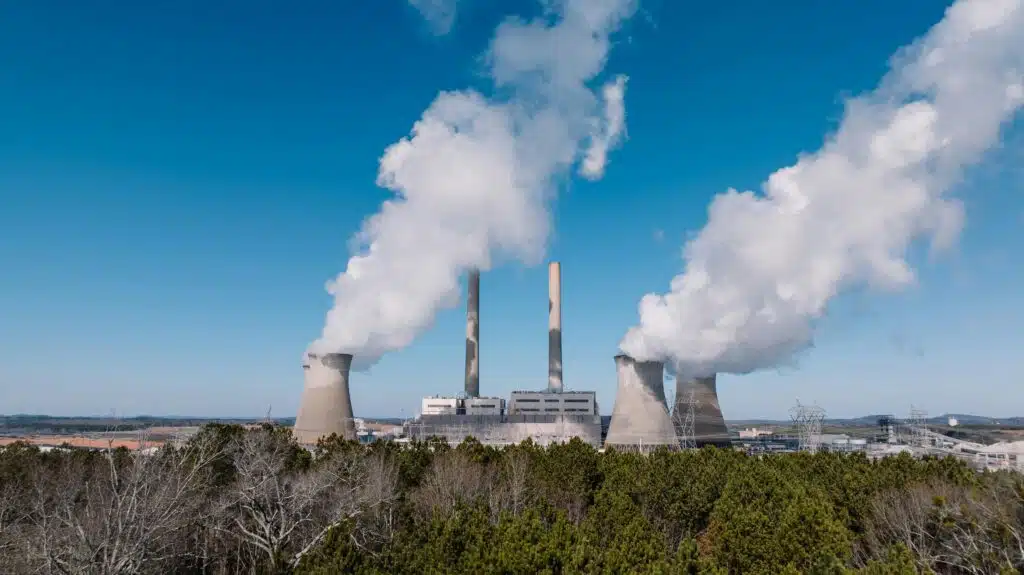
In the debate on carbon neutrality, attention often focuses on power stations, industry or transport. However, urban infrastructure itself generates a significant proportion of indirect greenhouse gas emissions.
 

Energy-intensive infrastructure by design and an often underestimated footprint

Roads, cycle paths and pedestrian areas require permanent equipment to function, secure and illuminate spaces. Street lighting is a prime example of this. Even when optimised (LEDs, presence detection, dimming), night-time lighting relies on: a continuous power supply, extensive cabling networks, poles, masts and electrical cabinets, and regular maintenance (replacement, inspection, servicing). These elements not only involve constant energy consumption, but also a carbon footprint linked to the manufacture, installation and maintenance of the equipment.

Night-time lighting accounts for a significant proportion of local authorities' energy consumption. At the regional level, this means recurring energy costs, indirect emissions linked to electricity production and dependence on heavy infrastructure.

In a context where local authorities need to drastically reduce their emissions, every item counts.


Rethinking the model

The question is no longer just about optimising what already exists, but about rethinking the need itself.
Solutions such as LuminoKrom®, which enable lighting without power supply, wiring or maintenance, make these transformations possible.

For more information

Check out our article on the lack of street lighting.
What are the causes of this situation? What are the alternatives?

LuminoKrom® : innovation at the heart of the ecological transition  


How can we reduce the carbon footprint of infrastructure without compromising safety ?

Innovative solutions are emerging to address these challenges. Among them is LuminoKrom®, a photoluminescent paint developed in France, which offers a practical and sustainable approach to improving night-time visibility without electricity.

What is LuminoKrom® ?

LuminoKrom® is a paint that absorbs natural or artificial light during the day and then releases it in the dark. Applied to cycle paths, pavements, pedestrian areas or road markings, it improves night-time visibility, enhances user safety and reduces the need for permanent electric lighting.

LuminoKrom® is a technology that works without a power supply, wiring or heavy energy infrastructure.


How LuminoKrom® can contribute to carbon neutrality

The positive impact of LuminoKrom® can be explained on several levels :

  • Reduction in energy consumption - By reducing the need for permanent electric lighting for certain infrastructure, LuminoKrom® directly lowers CO₂ emissions linked to electricity production and consumption, and helps reduce the carbon footprint of urban developments.
  • Reduction in heavy infrastructure - The absence of wiring, poles and energy-intensive equipment not only reduces emissions produced during the manufacture of materials, but also those associated with their maintenance.
  • Energy efficiency and sustainability - The ease of installation and long service life of LuminoKrom® are part of an energy efficiency approach, a central principle of low-carbon strategies.


An innovation aligned with the 2050 objectives

The European goal of carbon neutrality by 2050 requires a profound transformation of infrastructure. Solutions that reduce energy consumption at source, rather than simply optimising existing systems, will be crucial.

LuminoKrom® exemplifies this new generation of innovations.

These characteristics make this solution a practical tool for local authorities and decision-makers who wish to incorporate more sustainable practices into their development projects.

Carbon neutrality is one of the major challenges of the 21st century. It is a global objective that requires structural transformation of our territories and infrastructure, ambitious policies and concrete innovations. By offering an alternative to traditional electric lighting for certain developments, LuminoKrom® demonstrates that it is possible to combine safety, energy efficiency and environmental performance without compromising the safety or functionality of public spaces.

Achieving carbon neutrality by 2050 will require a combination of global actions and concrete local solutions. This complementarity between climate objectives and practical solutions is essential to accelerate the ecological transition.

It is precisely in this complementarity that technologies such as LuminoKrom® come into their own.