Emergency exit signage: ensuring safe emergency evacuation in the workplace

04/03/2026
All LuminoKrom® news
Table of contents


In businesses, industrial sites, or establishments open to the public, quickly identifying an emergency exit is essential to ensuring effective emergency evacuation. 


While regulations strictly govern the signage of evacuation routes, certain adverse situations can limit the effectiveness of traditional systems. Ensuring reliable guidance, even when emergency lighting becomes insufficient, is therefore a major challenge for operators and HSE managers.

Photoluminescent signage for emergency exits provides autonomous and durable visibility, capable of guiding people to safety in all circumstances.

Discover the systems adapted to professional environments on our page dedicated to emergency signage for industry.

Why identifying emergency exits remains a critical issue


In professional and industrial environments, effective crisis management depends above all on the ability of staff to quickly identify a clearly marked emergency exit. While escape routes are generally known in normal situations, certain events can profoundly alter the perception of space and complicate the search for a safe exit, including:

  • a fire,
  • smoke reducing visibility,
  • a power cut plunging certain areas into darkness.

In complex buildings such as logistics warehouses, industrial sites, or high-traffic public buildings, signage must not only meet regulatory requirements: it is a genuine risk management tool, capable of guiding individuals when their usual landmarks disappear.


Disorientation and human behavior during an evacuation

When faced with an emergency situation, human reactions are not always rational. Under stress, those affected tend to seek out familiar routes rather than planned evacuation routes, which can cause slowdowns or crowding in certain areas.

Impaired vision and difficulty in quickly analyzing environmental information reinforce this phenomenon. Signage that is immediately legible, visible from multiple angles, and visible throughout the route can help limit hesitation and naturally guide people to the nearest exit, particularly in stairwells or complex circulation areas.

Loss of visibility and smoke: a major aggravating factor

incendie-batiment-fumee

During a fire, smoke is often the main obstacle to rapid evacuation. As it accumulates at height, it can obscure traditional signs and significantly reduce the visibility of escape routes.

When visibility is poor, employees instinctively move closer to the ground, where the air is more breathable.

In these conditions, it becomes essential to maintain visible landmarks at different levels to guide movement and prevent orientation errors, particularly in industrial sites or long, compartmentalized corridors.

Emergency exit and business continuity plan: anticipate power loss and disruption

Identifying emergency exits is also part of modern crisis management and business continuity planning (BCP) strategies. Several situations can render certain essential equipment inoperable, including part of the lighting systems:

  • a fire affecting the facilities or generating heavy smoke,
  • a technical incident affecting the building's infrastructure,
  • a prolonged power outage or failure of the electrical grid.

In an industrial or logistics site, the loss of power can quickly plunge certain areas into darkness and disrupt the teams present. Having signage that remains visible without relying entirely on a power source helps to ensure the immediate safety of people in the building while limiting the effects of disorientation associated with the crisis situation.

Regulations and obligations concerning emergency exits in public buildings and industry

The design and signage of emergency exits must comply with specific regulatory requirements intended to ensure the rapid and safe evacuation of individuals. In France and throughout Europe, these requirements apply to establishments open to the public (ERP) as well as industrial sites and commercial buildings housing employees.

Beyond the simple presence of an exit, the regulatory framework requires a comprehensive approach that includes accessibility, permanent visibility, and maintenance of protective devices.


Number and accessibility of emergency exits

The number of emergency exits required depends mainly on the capacity of the site, its activity, and its architectural configuration. Regulations applicable to public buildings and the Labor Code for companies generally require the presence of several exits in order to avoid any bottlenecks during an evacuation.

In industrial or logistics environments, where traffic patterns can change over the course of the day, keeping these routes clear is a daily challenge. An exit that is perfectly compliant in theory can quickly become ineffective if access to it is obstructed or poorly identified.

Mandatory signage and ISO standards

The visibility of emergency exits relies on standardized signage that can be understood immediately, regardless of the language or level of knowledge of the occupants.

At the European level, ISO 7010 defines the safety pictograms used to identify emergency exits and evacuation routes. These symbols, recognizable by their green background and moving figure, are designed to convey universal information that can be quickly interpreted.

Regulations also require that these signs remain visible at all times, even in the event of a failure of the main lighting. They can be combined with self-contained lighting devices or passive technologies that remain legible without a power supply.

Maintenance and periodic checks

Installing compliant signage is not enough: its effectiveness also depends on keeping it in good working order. Operators must carry out regular checks on safety devices, in particular emergency lighting and associated equipment.

Autonomous emergency lighting units (BAES), for example, require periodic checks to verify their autonomy and the proper functioning of their batteries. An undetected failure can compromise the visibility of escape routes at a critical moment.


Operator responsibility and safety obligations

Beyond functional aspects, legal provisions directly engage the operator's or employer's responsibility for personal safety. The Labor Code requires the implementation of measures to ensure rapid and safe evacuation in the event of danger.

In the event of an accident or fire, the absence of appropriate signage, poor maintenance, or inadequate organization of evacuation routes may be considered a breach of safety obligations.

When safety lighting is no longer sufficient

Safety lighting is an essential part of evacuation systems in commercial buildings. Self-contained emergency lighting units (SLEUs) and centralized systems normally provide a minimum level of lighting to guide users to emergency exits in the event of a failure of the main power supply.

However, feedback from real incidents shows that these systems, although regulatory and essential, do not always cover all the adverse situations a building may face. Prolonged power cuts, maintenance failures, or severely impaired visibility can limit their effectiveness at critical moments.

Power failure and BAES malfunction

BAES de secours

BAES are designed to automatically take over in the event of a power failure. However, their autonomy depends on built-in batteries, which have a limited operating time. In certain situations, this autonomy may be exceeded before the evacuation or safety operations are complete, in particular during a major fire requiring prolonged intervention, in the event of a technical incident with a lasting impact on the facilities, or when rescue operations are prolonged.

In addition, several factors can reduce the expected performance of the equipment:

  • an aging battery,
  • insufficient maintenance,
  • harsh environmental conditions (temperature, humidity, or dust).

Maintenance and energy dependence: constraints that are often underestimated

technicien pour maintenance électrique

Beyond their technical operation, emergency lighting systems require regular maintenance.

Periodic checks, autonomy tests, and battery replacement are essential to ensure their long-term effectiveness.

In large buildings or industrial sites that operate continuously, these operations can represent a significant organizational constraint. Equipment installed at height or in technical areas that are difficult to access sometimes requires specific interventions, increasing the cost and complexity of monitoring.

Furthermore, energy dependence remains a key factor. A prolonged power failure, a secondary power supply failure, or a crisis situation affecting several systems simultaneously can limit the availability of active devices.

Is it necessary to install lighting for emergency exits?

Regulations require that emergency exits remain identifiable in all circumstances, particularly when normal lighting fails. This requirement is most often met by installing protective lighting capable of providing a minimum level of illumination. However, lighting is not the only way to ensure that an evacuation route is clearly visible. In certain situations, particularly when smoke severely reduces visibility or when power is unavailable, additional devices can be used to help guide people to safety.

Passive signage solutions, which remain visible without a power supply, thus contribute to the redundancy of safety systems. They do not replace regulatory installations but help to maintain continuous reference points when conditions become particularly poor. This complementarity is in line with the logic of a comprehensive protection system: increasing the number of sources of visual information helps to limit disorientation and assist movement even when the environment is changing rapidly.

This is why many organizations are now seeking to supplement existing installations with systems capable of ensuring autonomous visibility, independent of any power source.

Photoluminescent signage: autonomous visibility towards emergency exits

Given the potential limitations of systems that depend on a power supply, photoluminescent marking is now establishing itself as a complementary solution designed to enhance the safety of evacuation routes. Based on materials capable of storing ambient light and releasing it in the dark, it allows markers to remain visible without an external energy source.

In professional and industrial environments, this autonomy is a major advantage. In particular, it helps to ensure safety during the first few minutes of evacuation, which are often crucial in preventing panic or misdirection.

Why low visibility becomes critical in the presence of smoke

During a fire, smoke is one of the main factors causing disorientation. As hot gases accumulate at height, they can quickly obscure signs above doors or hanging from the ceiling, making it more difficult to read them.

As a reflex, people then try to move closer to the floor, where the air is generally more breathable and visibility is slightly better. In this situation, the presence of continuous low-level light markers becomes particularly effective in maintaining clear orientation.

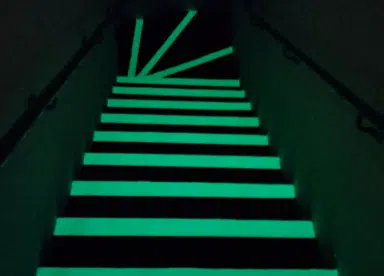
Photoluminescent markings applied to the bottom of walls, stair nosings, or side walls thus make it possible to identify the path to the emergency exit even when overall visibility is severely impaired. This visual continuity naturally guides movement without requiring any effort to interpret.

marquage luminescent escaliers secours

Stairs and walkways: the most critical areas during an evacuation

Stairs and vertical circulation routes are among the most sensitive areas during an evacuation. Changes in level, sharp turns, and heavy traffic increase the risk of falls or slow down the flow of people. A loss of lighting in these spaces can quickly create a blocking effect, especially when people are reluctant to enter an area they perceive as dark or uncertain. In underground parking lots, enclosed stairways, or multi-level industrial buildings, this situation can significantly slow down the evacuation of people.


The integration of photoluminescent signage on steps, handrails, or walls allows for immediate reading of the environment. People on site can thus identify the continuity of the route, anticipate changes in direction, and maintain a more fluid pace of movement.

marquage luminescent escaliers secours

Complementarity between safety lighting and photoluminescence

Photoluminescent signage is not a substitute for the safety lighting devices required by law. It acts as a complement designed to reinforce the redundancy of guidance systems. This complementarity also offers operational advantages. By reducing exclusive dependence on electrical equipment, it contributes to the overall resilience of the site in the event of adverse conditions. Its passive operation also limits technical maintenance requirements, while offering immediate visibility as soon as the light disappears.

In industrial environments or high-traffic public buildings, combining active devices and autonomous solutions thus makes it possible to increase the levels of protection and effectively guide occupants to emergency exits regardless of the conditions encountered.

Practical applications in industry and commercial buildings

While the principles governing emergency exit signage are common to all buildings, their implementation varies greatly depending on operational constraints. Space layout, occupancy levels, specific risks, and lighting conditions directly influence how evacuation routes must be secured.

Industrial sites and logistics warehouses

entrepot logistique

Industrial sites and logistics platforms often have large surface areas, long circulation routes, and a changing layout linked to production or storage activities. Several elements can create visual obstacles and limit the visibility of emergency exits, including:

  • high shelving,
  • large industrial machinery or equipment,
  • compartmentalized technical areas,
  • storage spaces whose layout changes regularly.

In the event of a power failure or technical incident, certain areas can quickly be plunged into darkness, particularly during night shifts or staggered working hours. Operators on site must then be able to immediately identify evacuation routes without relying solely on active lighting.

Photoluminescent markings applied along walkways, at fire doors, or at changes in direction help to create a continuous path to emergency exits. They also help to secure transition areas between workshops, logistics platforms, or storage areas where landmarks may change over time.

Parking lots and basements

application-parking

Covered parking lots and underground levels present particular challenges in terms of evacuation. Several factors can make orientation difficult, even under normal conditions:

  • the absence of natural light,
  • large spaces that are sometimes poorly compartmentalized,
  • the repetition of similar spaces that can disorient individuals.

In the event of a vehicle fire or technical incident, the rapid spread of smoke can significantly reduce visibility. Visitors, who may be unfamiliar with the premises, must then quickly find a staircase or pedestrian exit.

Photoluminescent markings installed on walls, handrails, or stairway access points ensure that the evacuation route remains clearly visible. Visible without a power supply, they provide continuous information even when the main lighting or some of the safety equipment becomes unavailable.

Enclosed staircases and vertical circulation routes

application-escaliers

Staircases are often the main evacuation route in a building. However, they also represent a risk area in the event of a loss of lighting or heavy traffic. Changes in direction, uneven steps, or reduced perception of levels can cause people to slow down and fall. In enclosed staircases, where natural light is often absent, the immediate visibility of steps and landings becomes essential. Photoluminescent markings can be applied to various strategic locations to maintain a clear perception of volumes and guide movement, in particular:

  • on the nosings of steps,
  • on risers,
  • along handrails,
  • on side walls or intermediate landings.

This visual continuity helps maintain a smooth evacuation flow, particularly in public buildings or multi-level industrial buildings, where stairways are essential.

Technical corridors and restricted access areas

couloir technique

Professional buildings often have areas that are not frequently used on a daily basis, including:

  • technical rooms,
  • maintenance corridors,
  • service galleries,
  • areas reserved for operating teams.

These environments often have limited lighting and more complex access. When an incident occurs, technicians or operators must be able to quickly reach an emergency exit, sometimes in areas they rarely visit in an emergency. Photoluminescent signage provides discreet but permanent guidance in these sensitive areas. By remaining visible even without power, it makes isolated interventions safer and reduces the risk of disorientation in compartmentalized or highly structured spaces.

Ensuring effective evacuation is not just a matter of having a compliant exit. In professional and industrial environments, occupant safety depends above all on their ability to quickly identify a clear route to an emergency exit, even when normal operating conditions no longer apply.

Human disorientation, smoke, power cuts, and maintenance constraints are reminders that active devices, although essential, can reach their limits in certain adverse situations. Improving the visibility of evacuation routes with additional equipment that can operate without a power supply therefore helps to improve the overall resilience of the building.

Photoluminescent signage is fully in line with this approach, offering autonomous, continuous, and immediately available visibility. Combined with existing regulatory equipment, it helps guide occupants to an emergency exit in all circumstances, while meeting the growing requirements of modern organizations for protection and business continuity systems.


Do you have a project and are considering photoluminescence?

Learn more

Is it mandatory to mark emergency exits?
Yes. In businesses and public buildings, regulations require that emergency exits and evacuation routes be clearly identifiable at all times.


How can you ensure that emergency exits are clearly visible?
Effective visibility depends on several complementary factors: consistent positioning of signs, appropriate safety lighting, and continuous markings along the entire evacuation route. In complex or low-light environments, the addition of autonomous solutions such as photoluminescent signage helps to maintain visible landmarks even in the event of a power failure or smoke.


What are the penalties for non-compliance with regulations?
Failure to provide signage or comply with safety requirements may result in civil and criminal liability for the operator or employer. In the event of an inspection or accident, administrative penalties, fines, or even temporary closure of the establishment may be imposed, particularly if the protection of persons is deemed insufficient.


Can photoluminescent signage replace safety lighting?
No. Safety lighting remains a regulatory requirement in most commercial buildings and public buildings. Photoluminescent signage is used as a complementary device to reinforce guidance continuity when visibility is reduced or when the power supply becomes unavailable.


How can you locate an emergency exit in case of smoke?
When smoke is present, visibility generally decreases at higher levels. People then tend to move closer to the ground, where the air remains more breathable. Continuous low-level signage, combined with clear directional signs, provides effective visual cues and guides people to the nearest exit.


What color should emergency exit signage be?
According to international safety standards, emergency exit signage generally uses a green background with white pictograms or arrow symbols. This combination ensures quick and universal recognition of the message, regardless of the language or level of knowledge of users.