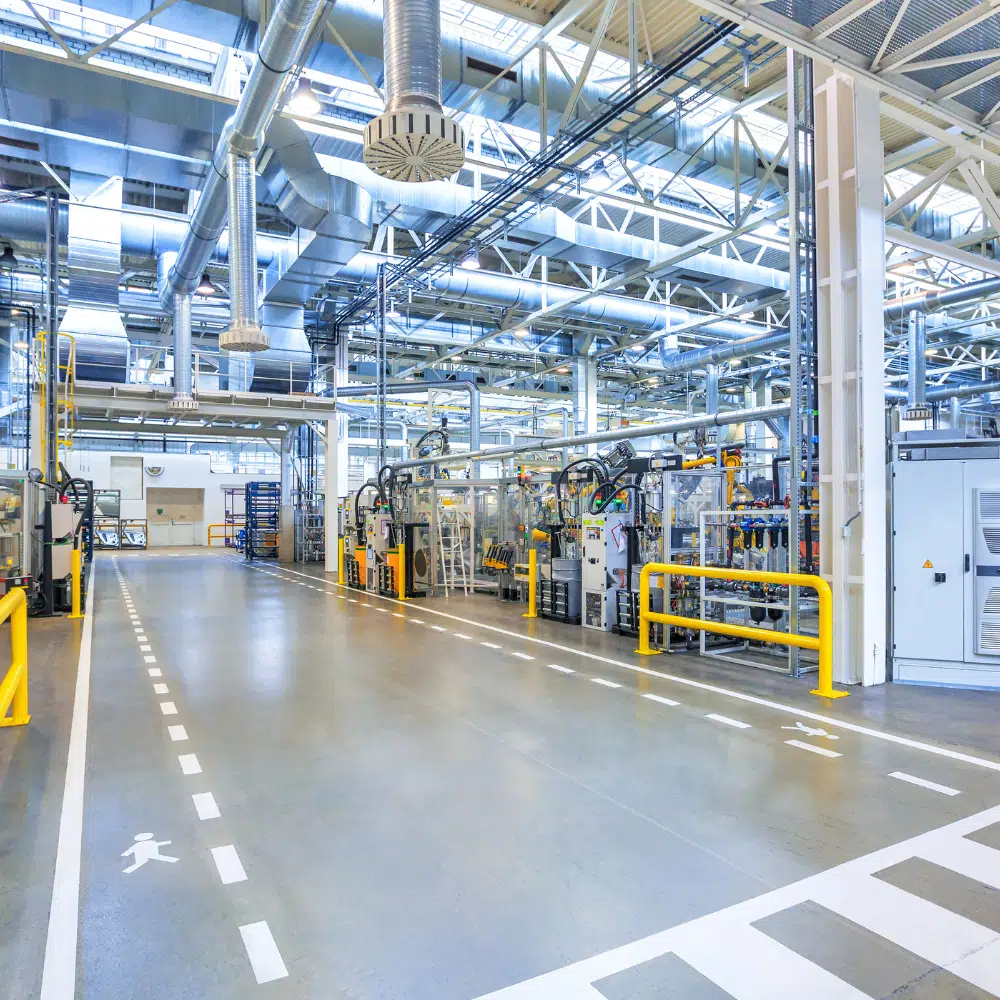
Why choose waterbased paint for industrial applications?
Choosing a waterbased product for professionnal applications offers many advantages, both environmental and practical.
Its formulation, rather than organic solvents, considerably reduces VOC (Volatile Organic Compounds) emissions and strong odors, providing a healthier working environment. It's also less flammable, easier to clean and safer to handle in confined spaces.
From a technical standpoint, today's waterbased paints for industry offer excellent resistance to abrasion and wear, while guaranteeing reliable adhesion to common substrates: concrete floors, walls, partitions, painted or unpainted metals and steel.
They dry quickly and are easy to clean with water, simplifying maintenance operations.
What types of surface can be painted with these products?
Aqueous paints for industry are highly versatile in application. They can be used on a wide variety of interior surfaces, for both technical and safety purposes.
Concrete, plaster and brick walls and partitions are the most common surfaces. These markings provide excellent coverage and uniformity, while offering lasting protection against wear and soiling.
They can also be applied to interior floors, particularly in high-traffic areas, workshops, corridors or access ramps.
This versatility makes waterborne industrial paint ideal for floor and wall signage, space delimitation, emergency exit safety and lighting in industrial environments.
Other luminescent solutions were created for steel or metal support > View our coating for metal
How do I choose the right industrial paint for my needs?
The choice of an industrial paint depends above all on its use, the type of surface and exposure conditions.
For indoor environments, compared to exterior places, aqueous paints are often required for their low solvent content, ease of application and compatibility with enclosed spaces.
If the desired function is signage or safety, a photoluminescent paint, such as LuminoKrom® coatings, is an optimal and resistant solution: it provides bright, self-contained light guidance in the dark in the event of a power cut.
It's also important to consider the choosen application system and tool (brush, spatula, spray gun, aerosol...) and the surface to be painted (metal parts, steel, walls, concrete floor...).
To assist you, we offer a range of photoluminescent products in different colors to be filtered according to your needs > View our complete catalogue
What are the advantages of choosing industrial paint?
Choosing an professional paint offers much more than just an aesthetic finish: it's an investment in safety, durability and quality. This type of coating is designed to withstand the mechanical and chemical stresses of professional environments: friction, impact, dust, humidity or temperature variations. They also help protect substrates, facilitate maintenance and maintain a clean, safe working environment.
Some ranges, such as LuminoKrom®, add a further functional dimension thanks to photoluminescent pigments, guaranteeing continuous visibility even without lighting.
Last but not least, waterbased paints specially made for industry combine technical performance with environmental commitment, by reducing solvent emissions and simplifying cleaning. In this way, they meet the expectations of today's companies, which are concerned with operator protection, ecology and industrial responsibility.
What specific applications are there in the industrial sector?
Industrial paints cover a wide range of applications, depending on site requirements and conditions of use. They are commonly used for safety signage: marking traffic lanes, risk areas, stairs, ramps or systems with emergency exits.
In factories and warehouses, they are used to demarcate storage areas, identify logistics aisles or mark out technical equipment.
Photoluminescent coatings such as LuminoKrom® are ideally suited to premises with no natural light, enabling autonomous night-time guidance.
Some formulations dedicated to metal substrates are also used to protect metal surfaces against corrosion and rust, or to improve the visibility of structural elements.
Industrial paints are therefore essential maintenance and safety tools, contributing to the reliability of installations, the prevention of everyday accidents and the protection of employees.
Reduce